
In the world of industrial automation, where machines are shrinking and expectations are rising, compact cylinders have quietly become one of the most important motion components. Their ability to deliver strong, clean, and controlled linear force from an extremely small footprint makes them invaluable for equipment designers who work inside tight spaces. Whether it’s a precision assembly robot, a compact packaging module, or a small-tool machine with almost no spare room, these cylinders step in to do the heavy lifting literally and figuratively. Yet their real value is unlocked only when engineers understand how they are mounted, cushioned, and maintained.
Mounting: Fitting Big Power Into Small Places
Mounting a compact cylinder isn’t simply a matter of attaching it to a machine. Because these cylinders are engineered for minimal length, they rely heavily on stable mounting to maintain alignment and smooth movement. If a traditional cylinder can tolerate a little flexibility, compact cylinders are far less forgiving, simply because their structure is shorter and their internal tolerances are tighter.
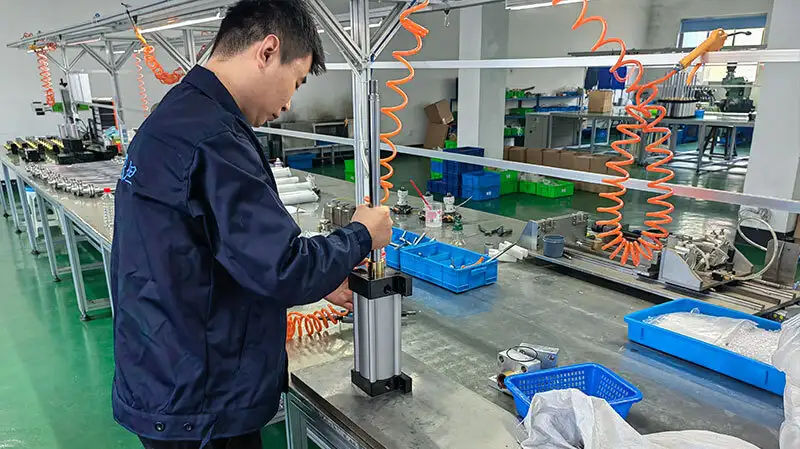
This is why mounting style matters so much. Through-hole mounting remains one of the most trusted methods because it holds the cylinder close to the machine surface, creating a solid anchor point. Flange mounting is equally popular in automated systems that require precise positioning without occupying too much vertical space. Some engineers choose threaded-body mounting when the cylinder needs to be built directly into a fixture or tool block.
What’s interesting is that mounting often becomes a collaborative process. Machine builders frequently rely on experienced pneumatic cylinder suppliers to help select the right configuration. A dependable pneumatic cylinder manufacturer, Titan Automation, can even customize hole patterns, material grades, or rod positions so the cylinder fits into a machine as naturally as a puzzle piece.
Cushioning: The Secret Behind Smooth and Silent Motion
Because compact cylinders operate within short strokes, they tend to move quickly sometimes faster than expected. Without cushioning, the piston would abruptly slam into the end of its travel path, creating noise, wear, and potential misalignment. That’s where cushioning becomes essential.
Fixed cushioning, built directly into the cylinder, provides a simple but effective way to soften the end-of-stroke impact. Adjustable cushioning, on the other hand, gives engineers control over how fast the piston decelerates. When working with delicate components or high-speed automation, having the ability to “tune” how the piston slows down can make all the difference in performance.
Good cushioning doesn’t just protect the cylinder it protects the entire machine. A smoother deceleration reduces vibration, minimizes stress on tooling, and supports more accurate positioning. Titan Automation, known globally for its engineering depth, integrates advanced cushioning mechanisms designed specifically to handle demanding OEM applications.
Maintenance: The Key to Long-Term Reliability
Compact cylinders might be small, but they work incredibly hard. That’s why proper maintenance is vital not complicated, but intentional. The first and most important rule is to keep the air supply clean. Moisture, dust, or oil contamination gradually damages seals, increases friction, and reduces efficiency. A clean air system instantly adds years to a cylinder’s useful life.
Regular inspections are also essential. Even a slight misalignment can place uneven stress on the rod, especially in compact cylinders where tolerances are tight. Seal wear, unusual sound during operation, or subtle changes in motion smoothness are early signs that attention is needed.
A trusted pneumatic cylinder manufacturer will always provide clear maintenance guidelines, replacement seal kits, and support services. Titan Automation, for example, provides full life-cycle assistance design, installation guidance, after-sales service, and component replacements ensuring that every cylinder continues to perform exactly as intended.
Why Compact Cylinders Are the Future of Automation
As machinery continues to shrink while expectations for speed and accuracy grow, compact cylinders are becoming the silent heroes of modern equipment design. They fit where other actuators can’t, they move with surprising power, and they simplify engineering challenges that once seemed impossible to solve. Combined with smart mounting choices, reliable cushioning, and intentional maintenance, these cylinders deliver long-lasting performance that keeps machines running smoothly around the clock.